

AMERICAN CONSERVATISM
The University of Toledo
Institute for American Constitutional Thought and Leadership
CLT 3990:001
- Instructor: Kevin Vallier
- Email: kevin.vallier@utoledo.edu
- Office Hours: By Appointment
- Office Location: UT Law School, Rm. 2007.
- Instructor Phone: 2517091958
- Offered: Spring 2025
- Course Website: TBD
- Class Location: TBD
- Class Day/Time: TBD
- Lab Location: N/A
- Lab Day/Time: N/A
- Credit Hours: 3
CATALOG/COURSE DESCRIPTION
This course offers a comprehensive examination of the history, principles, and influential thinkers of American conservatism. Students will explore the philosophical foundations of conservatism, from Edmund Burke to modern-day theorists, and trace its development in the United States. Key figures include Friedrich Hayek, Russell Kirk, and William F. Buckley Jr. The course will also explore diverse strands within conservatism, including traditionalism, libertarianism, and neoconservatism. Through readings, discussions, and essays, students will better understand conservatism’s impact on American political thought and society.
COURSE OVERVIEW/ TEACHING METHODOLOGY
This course combines lectures, discussions, student presentations, and written assignments to provide a comprehensive understanding of American conservatism. Students will engage with primary texts, analyze key conservative thinkers’ ideas, and develop their critical thinking skills through presentations and essays.
STUDENT LEARNING OUTCOMES
By the end of this course, students will be able to:
- Explain the historical development of American conservatism
- Analyze the key principles and ideas of major conservative thinkers
- Compare and contrast different strands of conservative thought
- Evaluate the impact of conservatism on American politics and society
- Develop and articulate well-reasoned arguments about conservative ideas
- Demonstrate effective oral and written communication skills
PREREQUISITES AND COREQUISITES
None
TEXTS AND ANCILLARY MATERIALS
Required Texts:


Schneider, G. L. (Ed.). (2009). Conservatism in America since 1930: A Reader. New York University Press.
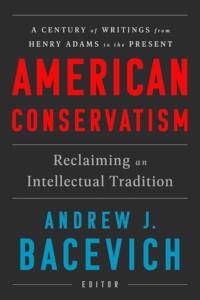
Bacevich, A. J. (Ed.). (2022). American Conservatism: Reclaiming an Intellectual Tradition. Library of America.
Additional readings will be provided through the course website.
EMAIL COMMUNICATION
Students are expected to use their University of Toledo email address for all course-related communication. I will typically respond to emails within 24 hours on weekdays and 48 hours on weekends. Please check your email regularly for important course announcements and updates.
TECHNOLOGY REQUIREMENTS
Students will need access to a computer with internet connectivity to access course materials, submit assignments, and participate in online discussions. Microsoft Word or a compatible word processor is required for writing assignments.
ACADEMIC POLICIES
Undergraduate Policies: http://www.utoledo.edu/policies/academic/undergraduate/
Graduate Policies: http://www.utoledo.edu/policies/academic/graduate/
COURSE EXPECTATIONS
Students are expected to:
- Complete all assigned readings before class
- Participate actively in class discussions
- Deliver five presentations throughout the semester
- Submit two papers (5 pages minimum each)
- Attend all classes and arrive on time

OVERVIEW OF COURSE GRADE ASSIGNMENT
- Class Participation: 20%
- Presentations (5 total): 35%
- Presentation 1 (Practice): 0%
- Presentation 2: 5%
- Presentation 3: 5%
- Presentation 4: 10%
- Presentation 5: 15%
- Papers (2 total): 30%
- Final Presentation: 15%
Midterm Grading
Midterm grades will be calculated based on class participation, completed presentations, and the first paper. These grades provide important feedback on your progress in the course.
Final Grading
The final grade will be determined using the following scale:
A: 93-100% | A-: 90-92% | B+: 87-89% | B: 83-86% | B-: 80-82% | C+: 77-79% | C: 73-76% | C-: 70-72% | D+: 67-69% | D: 63-66% | D-: 60-62% | F: Below 60%
STATEMENT ON USE OF ARTIFICIAL INTELLIGENCE TOOLS
The use of AI tools, such as ChatGPT, for generating content for assignments is not permitted in this course unless explicitly authorized for a specific task. All work submitted should be your own original thinking and writing. If you have questions about the appropriate use of AI tools for research or brainstorming, please consult with me during office hours.
UNIVERSITY POLICIES
Institutional Classroom Attendance Policy
Please be aware that the university has implemented an attendance policy, which requires faculty to verify student participation in every class a student is registered at the start of each new semester/course. For this course, if you have not attended/participated in class (completed any course activities or assignments) within the first 14 days, I am required by federal law to report you as not attended. Unfortunately, not attending/participating in class impacts your eligibility to receive financial aid, so it is VERY important that you attend class and complete coursework in these first two weeks. Please contact me as soon as possible to discuss options and/or possible accommodations if you have any difficulty completing assignments within the first two weeks.
Policy Statement on Non‐Discrimination on the Basis of Disability (ADA)
The University is an equal opportunity educational institution. Please read The University’s Policy Statement on Nondiscrimination on the Basis of Disability Americans with Disability Act Compliance.
Academic Accommodations
The University of Toledo embraces the inclusion of students with disabilities. We are committed to ensuring equal opportunity and seamless access for full participation in all courses. For students who have an Accommodations Memo from the Office of Accessibility and Disability Resources, I invite you to correspond with me as soon as possible so that we can communicate confidentially about implementing accommodations in this course.
For students who have not established accommodations with the Office of Accessibility and Disability Resources and are experiencing disability access barriers or are interested in a referral to health care resources
Religious Accommodations
A student is permitted to be absent, without penalty, for up to three days each academic semester to take holidays for reasons of faith or religious or spiritual belief system or to participate in organized activities conducted under the auspices of a religious denomination church, or other religious or spiritual organization. 3364-71-30 Religious accommodations policy and 3364-71-30.01 Religious accommodations procedure.
Grievance procedure
A student may notify the institution of any grievance regarding the policy’s implementation using the 3364-71-05.1 Academic grievance procedure.
ACADEMIC AND SUPPORT SERVICES
Please use this link to explore the wide array of resources and services available to you as a student: https://www.utoledo.edu/success/
SAFETY AND HEALTH SERVICES FOR UT STUDENTS
Please use the following link to view a comprehensive list of Campus Health and Safety Services available to you as a student and click here for information on the Office of Public Safety.
COVID-19 HEALTH AND SAFETY STATEMENT
We will follow current university policy pertaining to COVID-19.
INCLUSIVE CLASSROOM STATEMENT
In this class, we will work together to develop a learning community that is inclusive and respectful. Our diversity may be reflected by differences in race, culture, political ideology, age, religion, sexual orientation, gender identity/expression, socioeconomic background, and a myriad of other social identities and life experiences. We will encourage and appreciate expressions of different ideas, opinions, and beliefs so that conversations and interactions that could potentially be divisive turn, instead, into opportunities for intellectual and personal development.